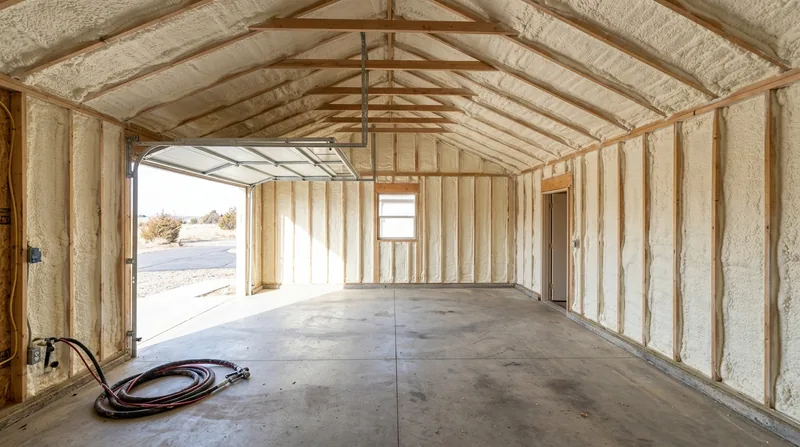




Garage spray foam insulation in Fort Collins transforms uninsulated or poorly insulated garages and shops into climate-controlled spaces that hold temperature through the region's dramatic seasonal swings. Fort Collins sits in IECC climate zone 5B, where garages face freezing winter mornings dropping below zero and summer afternoons pushing into the 90s without any thermal barrier between the living space and the elements. Most garages in the area, whether attached to homes in Old Town, newer subdivisions toward Loveland and Windsor, or detached shops across Larimer County, arrive without insulation or with thin fiberglass that has settled and lost its R-value over decades. Spray foam on walls and ceilings seals air leaks, stabilizes interior temperature, and keeps concrete floors from turning into heat sinks in winter or radiating absorbed summer heat into the home. We spray foam garages and shops across Fort Collins and the surrounding areas, working with homeowners and builders to stop the temperature swings that make garages unusable half the year.
Why Garage Insulation Matters in Fort Collins's Extreme Temperature Swings
An uninsulated garage is not just cold in winter and hot in summer, it is a thermal liability that pulls conditioned air from the home and drives energy waste across the entire house. The stack effect in Fort Collins homes pushes warm air up and out through hot attics and into uninsulated garages, while winter air leakage through garage walls and ceilings cools the rim joists and basement floors of attached homes. Spray foam stops that exchange, holds temperature inside the garage, and protects the thermal envelope of the main house. Fort Collins homeowners often discover the problem when their heating bills spike in January or when they cannot use the garage as a workshop because the temperature swings make it unbearable.
- Spray foam seals every gap, crack and penetration in garage walls and ceilings, stopping the air leakage that fiberglass cannot address.
- Closed cell foam adds structural rigidity to garage walls and resists moisture, critical in a space that may sit unheated for weeks during cold snaps.
- Open cell foam costs less and still delivers thermal resistance, appropriate for garages in climate-controlled areas or where budget is the priority.
- A properly insulated garage reduces the heating and cooling load on the main house, especially in attached garages where the wall between garage and home is often the weakest thermal boundary.
These benefits compound over time, and the payoff is most visible in January and February when Fort Collins temperatures dip below zero and every uninsulated surface becomes a heat loss point.
Key info: Attached garages in Fort Collins subdivisions like Timberline and areas near Colorado State University lose conditioned air through rim joists and top plates at the garage-home boundary. Spray foam on the garage ceiling and upper walls seals those leak points and stops the stack effect from pulling heat out of the home.
For more on how air sealing and spray foam work together to stop energy waste, see our page on air sealing in Fort Collins.
How We Insulate Garages in Fort Collins: Process and Application Methods
Garage spray foam insulation begins with a site visit to assess the existing insulation, identify air leaks at rim joists and penetrations, measure ceiling height and wall square footage, and confirm the condition of the substrate. We discuss whether the garage is attached or detached, whether it is heated or unheated, and whether the primary goal is thermal resistance, moisture control, or both. The job is then planned to the specific dimensions and needs of that garage, and we provide a written estimate with R-value and thickness specifications so you know exactly what you are getting.
- We inspect the garage ceiling and walls for existing insulation, moisture, or damage, and plan the foam application accordingly.
- Mechanical ventilation runs during the spray and cure process to manage off-gassing and ensure safe conditions for the crew and homeowner.
- We apply foam in controlled passes, maintaining proper drum temperature and manufacturer ratio to achieve the specified R-value and thickness without voids or thin spots.
- After application, the garage remains sealed for the re-entry window, typically twenty-four to forty-eight hours, allowing the foam to cure fully before use.
- Once cured, foam is inspected for coverage and thickness, and any thermal or ignition barriers required by code are installed.
The entire process is transparent, and we document the R-value, thickness, and coverage in writing so you have a record of what was installed and why.
Example: A detached garage in Windsor with a 24-foot by 20-foot ceiling and single-layer walls receives open cell foam at 4 inches on the walls and 6 inches on the ceiling, delivering R-14 and R-21 respectively. The job takes one day, mechanical ventilation runs for eight hours, and the garage is ready for use the next morning. A similar attached garage in Fort Collins requires foam on the garage-home wall boundary as well, adding to the scope and the value of the insulation because it stops conditioned air from escaping into the home.
For details on how open cell spray foam compares to closed cell options, see our open cell page.
| Approach | Description | Best for |
|---|---|---|
| Open Cell Spray Foam | Lower density, softer foam applied in thicker passes to reach desired R-value. Low-VOC once cured. Absorbs some sound. | Detached garages, shops, climate-controlled spaces, budget-conscious projects where moisture is not a primary concern. |
| Closed Cell Spray Foam | High density, rigid foam achieving higher R-value per inch. Resists moisture and vapor. Adds structural strength to walls. | Attached garages, unheated spaces exposed to seasonal moisture, metal buildings, applications where thermal and moisture control are both priorities. |
| Ceiling-Only Retrofit | Foam applied to garage ceiling only, often paired with fiberglass or blown-in insulation on walls if existing insulation is sound. | Garages where walls are already insulated or budget allows only the highest-impact area. Reduces summer heat gain significantly. |
| Full Wall and Ceiling Encapsulation | Spray foam applied to all walls and ceiling, creating a complete thermal and air barrier. Addresses rim joists and top plates. | Attached garages, garages used as living or working space year-round, properties where energy efficiency and comfort are the primary drivers. |
Garage Spray Foam Insulation Cost in Fort Collins: What to Expect
Garage spray foam insulation in Fort Collins starts at around $1,200 for a small detached garage with open cell foam on the ceiling and basic wall coverage. The final cost depends on several concrete factors: the square footage of walls and ceiling, the depth of foam required to reach your target R-value, whether the substrate is clean and dry, access for the spray rig, and whether existing insulation must be removed first. An attached garage typically costs more than a detached one because the garage-home wall boundary requires careful attention and often a thermal barrier to meet code. A 400-square-foot garage with 8-foot ceilings and open cell foam at 4 to 6 inches typically runs $1,500 to $2,500, while a larger or more complex job with closed cell foam or full wall coverage can reach $3,500 to $5,000 or more.
The best approach is to get two or three estimates from local contractors, each with written specifications for R-value and thickness so you can compare apples to apples. Avoid any estimate that omits thickness and R-value or that offers a price far below the market without explaining why. Visit our pricing page for more detail on what moves the cost up or down.
What to Look for When Hiring a Spray Foam Insulation Contractor Near Fort Collins
Hiring a spray foam contractor is a significant decision, and the difference between a careful installer and a careless one shows up within weeks of the job. A reputable contractor will provide a written estimate with R-value and thickness specifications, explain the cure time and re-entry window, and walk you through the process so you know what to expect. Verify that the contractor is fully insured and can provide proof of coverage. Ask for references from recent jobs in Fort Collins or nearby areas, and follow up with at least one to confirm the quality of the work and the contractor's responsiveness after the job.
- Request an estimate with detailed specifications including R-value per inch, total thickness, foam type (open or closed cell), and coverage area in square feet.
- Confirm that mechanical ventilation will run during the spray and cure process, and ask about the re-entry window before you can use the garage.
- Verify full insurance coverage and ask whether the contractor carries a workmanship warranty on the installation itself, separate from any manufacturer warranty on the foam product.
- Check references from local Fort Collins or Loveland projects, and ask specifically about the contractor's responsiveness if issues arose after the job was complete.
- Understand what permits or inspections may be required at your address in Fort Collins, and confirm that the contractor is familiar with the local building department's expectations for garage insulation.
A contractor who avoids these details or pressures you to decide on the spot is a signal to walk away and call someone else. Contact us at (970) 672-0707 or visit our contact page to request a free, no-obligation estimate for your garage.
Garage Spray Foam Insulation in Fort Collins: Pricing Guide
| Service | Price | Details |
|---|---|---|
| Small detached garage, open cell, ceiling only | Starting at $1,200 | Up to 300 square feet, 4-6 inches open cell foam on ceiling, includes basic wall air sealing |
| Standard detached garage, open cell, walls and ceiling | Starting at $1,800 | 300-500 square feet, 4-6 inches open cell on all surfaces, typical Fort Collins garage size and scope |
| Attached garage or closed cell application | Starting at $2,400 | Attached garages, closed cell foam, or projects with moisture control priority; larger square footage or multiple rooms |
| Insulation removal plus spray foam retrofit | On estimate | Removal of old fiberglass or failed foam, substrate prep, and new foam application require on-site inspection for accurate pricing |
| Travel and estimate | Included and free | No travel charge within Fort Collins and surrounding Larimer and Weld County areas; free estimate with 24-hour response time |
Indicative pricing, the exact cost depends on square footage, finish, and site access. Free personalized estimate within 24h at (970) 672-0707.


