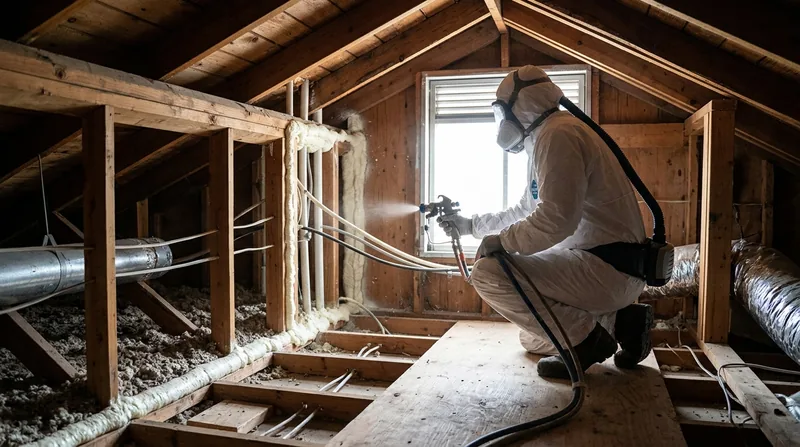




Air sealing in Fort Collins stops the stack effect that pulls heated air up and out through your attic in winter, then lets hot attic air push back down into living spaces in summer. In our dry zone 5B climate, air leakage, not moisture, drives most energy loss. Older homes in Old Town and near Colorado State University are classic drafty candidates, with gaps at top plates, wall penetrations and rim joists doing far more damage than any humidity problem. Mid-century ranches scattered through Fort Collins carry original insulation that has thinned with age, while newer subdivisions toward Loveland, Windsor and Timnath bring bigger attic volumes that take a beating from strong summer sun. We seal the points where conditioned air actually escapes, using spray foam insulation to air seal attics, crawl spaces, rim joists and walls. The result is lower utility bills, fewer cold floors in winter and better temperature control year-round.
Why Air Sealing Matters in Fort Collins Homes
Fort Collins sits in a dry climate where winter heating and summer cooling losses track directly to air leakage, not vapor drive or humidity. The stack effect pulls warm air upward and out through ceiling penetrations, attic hatches, and rim joists at the top of basement walls, while cold outside air infiltrates through the same paths in winter. A home that is not air sealed loses conditioned air constantly, forcing your heating and cooling system to run longer and work harder. Energy audits across Larimer County show that sealing these gaps cuts utility bills more reliably than adding insulation alone.
- We identify and seal gaps at top plates where walls meet attic framing, stopping air movement before it enters the attic.
- We seal penetrations around electrical wiring, plumbing vents and HVAC ducts that pass through the attic floor or rim joist.
- We seal rim joists and band joists at the basement perimeter to prevent cold air infiltration and heat loss through floors above.
- We seal garage walls and ceilings to prevent unconditioned garage air from mixing with living space.
- We seal wall cavities in retrofits where injection foam closes air pathways in existing wall assemblies without demolition.
Sealing these points is the single most cost-effective upgrade in a dry climate like ours, and it works regardless of whether you add new insulation afterward.
Fort Collins air sealing fact: Most homes built before 1990 in Old Town, near CSU and throughout the mid-century neighborhoods have never been systematically air sealed. Basement rim joists are a recurring weak point, and attic penetrations around electrical boxes and flue pipes are almost never sealed in the original construction.
For more on how spray foam works in attics, see our attic spray foam insulation page. To learn about sealing crawl spaces, visit our crawl space spray foam service.
For official guidance on energy code requirements in Fort Collins, the City of Fort Collins Building Permits and Inspections page governs what applies to your address and whether permits are required.
How We Air Seal in Fort Collins: Our Process
Air sealing is not a spray-and-go job. We start with a visual inspection to locate the actual air pathways in your attic, crawl space or walls. We then apply closed cell or open cell spray foam to seal those gaps, working systematically from the perimeter inward. The foam expands and hardens, creating an air barrier that also adds insulation value. We work with controlled thickness and proper ventilation during cure, and we do not rush re-entry.
- We inspect the attic, rim joist or wall cavity to map air leaks and plan the sealing strategy.
- We set up mechanical ventilation to manage off-gassing during and after the spray, with a clear re-entry window of 24 to 48 hours.
- We apply foam in controlled passes, respecting the manufacturer thickness per pass and drum temperature specs.
- We seal rim joists, top plates, penetrations and any other gaps where air movement occurs.
- We walk you through the cure timeline and post-cure expectations, including any odor and ventilation needs.
The result is a continuous air barrier that holds year after year, with no settling or degradation like fiberglass experiences.
Local example: A 1970s ranch in Fort Collins with an unfinished basement and original rim joist insulation has cold floors every winter. We seal the rim joist with closed cell foam, which also adds R-value and stops moisture from wicking into the rim band. The homeowner typically reports warmer basement floors and lower heating bills within the first heating season.
For details on the closed cell versus open cell choice, see our closed cell spray foam page.
Air Sealing Methods and Approaches
| Approach | Description | Best for |
|---|---|---|
| Attic air sealing with closed cell foam | High-density closed cell foam (2 lb) sprayed at top plates, penetrations and rim board to create an air and moisture barrier. | Attics with existing insulation, rim joists, and any space where you want maximum R-value and air stopping power in one pass. |
| Attic air sealing with open cell foam | Low-density open cell foam (0.5 lb) sprayed at penetrations and top plates, offering air sealing with slightly lower R-value but lower cost. | Attics where air sealing is the primary goal and R-value is secondary, or where budget is a major factor. |
| Rim joist and band joist sealing | Closed cell foam applied to the rim board perimeter and band joist to stop cold air infiltration and heat loss through basement rim. | Basements with cold floors, homes with unfinished basements in Fort Collins and Loveland, and any rim joist visible from below. |
| Wall cavity injection foam | Closed cell foam injected into existing wall cavities through small holes, sealing air pathways and insulating without demolition. | Pre-1980 homes with hollow walls, retrofit projects in Old Town Fort Collins, and any wall where you cannot open the exterior. |
| Garage air sealing | Spray foam applied to garage walls and ceiling to seal air pathways and prevent unconditioned garage air from entering living spaces. | Attached garages in Fort Collins subdivisions where garage temperature swings affect adjacent living areas. |
Air Sealing Cost in Fort Collins: What to Expect
Air sealing projects in Fort Collins typically start at $650 for small, targeted jobs such as sealing an attic hatch and a few penetrations. Most full attic air sealing jobs in a typical Fort Collins home range from $1,200 to $3,500, depending on attic square footage, the number of penetrations, and whether existing insulation must be moved or removed first. Rim joist sealing alone runs $800 to $2,000 for a typical basement perimeter. Injection foam in walls costs more per board foot because of the labor to drill, inject and seal each hole.
The main factors that move your estimate up or down are:
- Attic size: larger attics have more perimeter to seal and more penetrations to address.
- Access: difficult attics with low headroom or cluttered storage take longer to seal safely.
- Existing insulation: if batts or blown-in must be moved to reach top plates, labor increases.
- Penetration count: more electrical, plumbing and HVAC holes mean more sealing points and more material.
- Substrate condition: wet, contaminated or leaking surfaces require remediation before foam, which adds cost and timeline.
Getting 2 or 3 estimates from local contractors is always smart. A good estimate includes the square footage of attic or rim joist, the board feet of foam, the R-value and thickness specs, and a breakdown of labor versus material. Avoid estimates with no thickness or R-value stated, no inspection on site, or prices far below market. For a detailed pricing overview, see our full pricing page.
Air Sealing Near Me: What Fort Collins Homeowners Should Know When Hiring
Hiring the right contractor for air sealing is as important as the work itself. The spray foam trade has rig-and-run crews from out of state, national franchises, and local shops. The differentiator is not a logo or a franchise fee, but how the contractor works: whether they inspect before estimating, whether they explain the difference between open cell and closed cell honestly, and whether they answer your questions about cure time and re-entry clearly. Start by checking that any contractor you call is fully insured with coverage that includes spray foam work. Ask for references from recent jobs in Fort Collins or nearby areas, and call at least two. A good contractor will walk you through the estimate, explain what is included, and tell you plainly if a cheaper option is the right answer for your situation.
- Verify that the contractor is fully insured for spray foam application and carries general liability coverage you can confirm with their insurance agent.
- Ask whether they pull permits if your city or county requires them for the work at your address, and who handles the permitting process.
- Request an estimate that includes attic square footage, board feet of foam, R-value, thickness per pass, and labor cost broken out separately.
- Call references from similar jobs completed in the past 12 months, and ask about cure time, smell, and whether the contractor was easy to reach after the work.
- If your home is in an HOA, confirm that exterior work on metal buildings or additions does not require architectural approval before work starts.
- Ask about the re-entry window: honest contractors state 24 to 48 hours and explain why mechanical ventilation is running during cure.
You are hiring a professional to seal your home and add insulation value. A contractor who takes time to inspect, explain and set clear expectations is the one worth calling back. Contact us for a free estimate and we will walk you through the process with no pressure and no obligation.
Air Sealing in Fort Collins: Pricing Guide
| Service | Price | Details |
|---|---|---|
| Small attic air sealing | Starting at $650 | Attic hatch, a few penetrations, minimal board feet. Ideal for top-up work on existing insulation. |
| Full attic air sealing | Starting at $1,200 | Typical Fort Collins attic with top plates, rim board and multiple penetrations sealed. Size and access affect final cost. |
| Rim joist and basement sealing | Starting at $800 | Standard basement perimeter in a mid-sized Fort Collins home. Larger basements or finished spaces may cost more. |
| Wall cavity injection foam retrofit | Starting at $1,500 | Pre-1980 home with hollow walls. Cost scales with square footage of wall area and number of injection holes required. |
| Complex or large-scale job | On estimate | Multi-story homes, large attics, crawl spaces with moisture issues or extensive wall retrofits require on-site inspection. |
| Free estimate | No charge | Response within 24 hours at (970) 672-0707. We inspect, measure and provide a detailed written estimate before you decide. |
Indicative pricing, the exact cost depends on square footage, finish, and site access. Free personalized estimate within 24h at (970) 672-0707.


