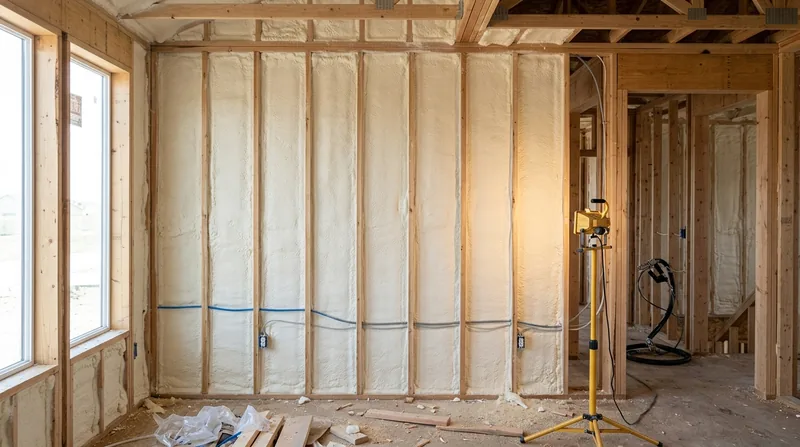




Commercial and new construction spray foam insulation in Fort Collins starts at the design phase, not after the frame is up. Builders across Larimer, Boulder and Weld counties work with us to plan foam application before drywall closes the walls, matching the energy code that governs your address. New construction in Fort Collins climbs from the foothills toward Loveland, Windsor and Timnath, where big roof planes face south and west into the intense Front Range sun. The dry climate and cold winters here mean air leakage through rim joists and top plates drives more heat loss than any moisture problem, and foam sealed during framing catches that loss before it starts. Commercial shells, warehouses, metal buildings and barndominiums across the region face the same challenge: condensation control on steel and uninsulated concrete, and sealed thermal envelopes that hold their shape and their value.
Why Commercial and New Construction Spray Foam Matters in Fort Collins
Fort Collins sits in IECC climate zone 5B, where builders must meet strict energy code requirements for new construction. Spray foam applied during framing, before drywall and exterior cladding go up, delivers continuous thermal control across walls, headers, rim joists and roof decks in a single pass. Commercial projects benefit from this early planning because foam bonds to the substrate as it cures, creating an air barrier and insulation layer at once. New construction homes in Fort Collins subdivisions, and the larger commercial builds moving into Loveland, Windsor and Timnath, use this window to lock in performance that fiberglass batts and blown-in cellulose cannot match.
- Plan foam application into your construction schedule before drywall and cladding close the cavities.
- Specify R-value and foam thickness in your energy code compliance documentation at the time of permit.
- Work with your builder to schedule foam spray before mechanical rough-in if possible, to avoid conflicts with HVAC and plumbing.
- Request written estimates that show R-value per inch, total thickness and board footage so you have a clear record for code verification.
- Confirm that your building department has approved the ignition barrier system and thermal barrier requirements for your project.
Early coordination between your builder, your foam contractor and your building department ensures the job moves on schedule and meets code the first time.
Key info: Fort Collins and surrounding jurisdictions enforce the International Energy Conservation Code (IECC) with local amendments. The fifteen-minute thermal barrier requirement for foam in certain applications is common in this region. Always verify with your local building department which ignition barrier and thermal barrier systems are approved at your address before you order materials.
For more detail on how we handle the energy code side of spray foam, see our closed cell spray foam page, which covers the technical specifications that drive new construction performance.
How We Plan and Execute Commercial and New Construction Spray Foam
New construction and commercial spray foam work requires coordination with your builder's schedule and your building department's inspection calendar. We meet on site early in the framing phase to review the scope, identify any substrate issues, and confirm the foam type and thickness that meets your energy code. Closed cell foam is the standard for new construction because it delivers high R-value in thinner applications, holds its shape under roof loads, and provides moisture control on metal and concrete. Open cell foam is used for sound dampening in commercial interiors and for cost-sensitive attic applications where moisture risk is low. We spray in controlled conditions, with mechanical ventilation running during cure, and we specify a re-entry window of twenty-four to forty-eight hours before drywall and cladding installation resumes.
- Walk the framing with your builder and building department to map the scope and confirm substrate conditions.
- Provide a written estimate with R-value per inch, total thickness, board footage and the ignition and thermal barrier system specified for your code.
- Coordinate the spray date to fit your construction schedule, typically after framing and before mechanical rough-in.
- Set up mechanical ventilation and establish a re-entry window before drywall and exterior cladding installation.
- Deliver a final report documenting thickness, R-value and application date for your building permit file.
This step-by-step approach keeps your project moving and gives your building department a clear record of compliance.
Example: A new construction home in the Timnath area required closed cell foam on the roof deck (R-30 in 5.5 inches) and in the rim joist band (R-25 in 4.5 inches) to meet the local energy code. We coordinated with the builder to spray after roof decking was complete but before the HVAC ductwork went in. The job took one day, and the homeowner had a complete thermal envelope before drywall closed the walls.
See our air sealing page for details on how foam application also stops air leakage at rim joists, top plates and other critical boundaries.
Commercial and New Construction Spray Foam Methods
| Approach | Description | Best for |
|---|---|---|
| Closed Cell Spray Foam | High-density foam (1.5 to 2.0 lb/cf) that cures to a rigid, dense layer. R-value is 6.0 to 7.0 per inch. Provides moisture control and structural rigidity. | New construction roof decks, rim joists, metal buildings, barndominiums, and applications where condensation control and high R-value in thin space are critical. |
| Open Cell Spray Foam | Lower-density foam (0.4 to 0.5 lb/cf) that cures to a soft, flexible layer. R-value is 3.5 to 3.8 per inch. Absorbs sound and allows vapor transmission. | New construction attics and interior walls where cost is a factor and moisture risk is low. Also used for sound control in commercial interiors. |
| Rim Joist and Band Joist Sealing | Closed cell foam applied to the rim joist cavity between floor joists and the foundation wall. Stops air leakage and heat loss at a critical thermal boundary. | New construction and retrofit work in Fort Collins, where basement rim joists are a major source of heat loss and cold floors. |
| Commercial Shell and Metal Building Insulation | Closed cell foam sprayed on the interior of metal studs and roof purlins. Prevents condensation on steel, provides thermal break and air seal in one application. | New commercial buildings, warehouses, barndominiums and metal pole barns across Larimer, Boulder and Weld counties where condensation control and energy efficiency are required. |
Commercial and New Construction Spray Foam Cost in Fort Collins: What to Expect
Commercial and new construction spray foam pricing in Fort Collins depends on the foam type, the total board footage, site access, and the complexity of the substrate. A free commercial estimate is your starting point. We measure the scope on site, verify substrate conditions, and provide a written quote that shows R-value, thickness and board footage so you have a clear record for your building permit file. Closed cell foam costs more per board foot than open cell, but delivers higher R-value and moisture control, making it the standard choice for new construction roof decks, rim joists and metal buildings. Open cell foam is a lower-cost option for attic applications where moisture risk is low and sound dampening is a benefit.
Factors that affect the final cost include the total area to be sprayed, the thickness required by your energy code, site access for the spray rig, substrate preparation (cleaning or repairs), and the distance from our Fort Collins location. Larger commercial projects and new construction homes that require foam across multiple zones (roof deck, walls, rim joists, garage) typically see a lower per-board-foot rate than small retrofit jobs. Always get two or three estimates from qualified contractors so you can compare not just price but also the R-value and thickness specifications they propose.
For detailed pricing information and to request your free commercial estimate, visit our pricing page or call us at (970) 672-0707.
What to Look for When Hiring a Spray Foam Insulation Contractor Near Fort Collins
Hiring the right spray foam contractor for your new construction or commercial project means verifying insurance, checking references, and confirming that the contractor understands your local building code. Fort Collins and surrounding jurisdictions in Larimer, Boulder and Weld counties each have their own permit and registration requirements, and there is no reciprocity between them. A qualified contractor will help you navigate what applies at your address, provide written estimates with R-value and thickness specifications, and deliver a final report documenting the work for your building department file.
Start by asking any contractor to show proof of current, verifiable insurance that covers spray foam work. Request at least two references from similar commercial or new construction projects completed in the past two years. Ask how they handle substrate preparation, what mechanical ventilation they use during cure, and what re-entry window they specify before drywall and cladding installation. Confirm that they understand the ignition barrier and thermal barrier requirements for your specific address and building type. If your project involves an HOA or master-planned community, verify that exterior work on metal buildings or barndominiums complies with architectural review rules. Finally, check with your local building department to confirm that any contractor you hire is registered or compliant with local registration requirements if they apply.
A contractor who walks the site early, provides a written estimate with clear specifications, answers questions about permits and code compliance, and is reachable during and after the job is the one to hire. Contact us for a free commercial estimate and to discuss how we work with builders and commercial developers across Fort Collins and the surrounding region.
Commercial & New Construction Spray Foam in Fort Collins: Pricing Guide
| Service | Price | Details |
|---|---|---|
| Free commercial estimate | Free | On-site walkthrough, R-value and thickness specifications, board footage calculation, written proposal within 24 hours |
| Closed cell spray foam, new construction | Starting at $1.50 to $2.50 per board foot | Varies by total area, thickness required by code, substrate condition and site access from Fort Collins location |
| Open cell spray foam, new construction | Starting at $0.85 to $1.35 per board foot | Lower cost than closed cell, suitable for attics and interior walls where moisture risk is low and sound control is desired |
| Large commercial or metal building projects | On estimate | Condensation control on steel, roof and wall coverage, and complexity of substrate require on-site assessment before pricing |
| Travel and setup | Included | No separate mileage or travel fee within Fort Collins and surrounding service area in Larimer, Boulder and Weld counties |
| Estimate response | Free | Call (970) 672-0707 for same-day or next-day scheduling, no obligation to book after estimate is provided |
Indicative pricing, the exact cost depends on square footage, finish, and site access. Free personalized estimate within 24h at (970) 672-0707.


